

SEMINARS 2026


OUR SPEAKERS 2026
- Rebecca Cosgriff
- Adam Hoyhtya, MS
- Aimee Walker-Clarke, PhD
- Andrew Walker, PhD
- Anke-Peggy Holtorf, PhD, MBA
- Charles Swanton, FRCP, PhD
- Daniel Aaron, JD, MD
- Fleur Chandler
- Fred D. Ledley, MD
- Gemma Taylor, PhD
- Grace Jennings, PhD
- Josie Godfrey
- Karen Facey, BSc, PhD
- Kerry Leeson
- Kseniya Prudyus, MSc
- Laurence Clark, MD, FACP
- Lindsay Birrell
- Nikki Holliday, MSc
- Oriol-Sola Morales, MD, PhD
- Piers Mahon, PhD
- Raffaella Ravinetto, PhD
- Reuben Guttman, JD
- Riley League, PhD
- Sophie-Mira Roberts
- Stelios Theophanous, PhD
- Stephany Saarti, PharmD
- Umbereen S. Nehal, MD, MPH, MBA
- Vanesa Huerta Carrera, MSc
- Walter G. Johnson, JD, PhD
- Wen Hwa Lee, PhD
Join vibrant discussions at Consilium Seminars: every other Thursday at 5pm London time
All our public seminars are available on our YouTube channel
SEMINARS 2026
Ambulance Taxis: The Impact of Regulation and Litigation on Health Care Fraud
February 12, 2026, 5pm London UK time
This talk is about the effectiveness of pay-and-chase lawsuits and upfront regulations for combating health care fraud. Between 2003 and 2017, Medicare spent $7.7 billion on 37.5 million regularly scheduled ambulance rides for patients traveling to and from dialysis facilities even though many did not satisfy Medicare’s criteria for receiving reimbursements. Using an identification strategy based on the staggered timing of regulations and lawsuits across the US, we find that adding a prior authorization requirement for ambulance reimbursements reduced spending much more than pursuing criminal and civil litigation did on their own. No evidence was found that prior authorization affected patients’ health.
From Patient Experience to Evidence: Human-Centered Design in Women’s Health AI
February 26, 2026 5pm London UK time
Umbereen S. Nehal, MD, MPH, MBA
Women’s health provides a practical case for examining how lived experience is incorporated into care pathways, platform design, and emerging AI-enabled tools.
In this seminar, Dr. Umbereen Nehal presents HER Heard as a use case for how community-based platforms can organize patient experience to support care navigation, service discovery, and decision-making. Drawing on clinician co-creation work, qualitative analyses of patient discourse, and ongoing platform development, the talk examines how lived experience can be structured for use in care and platform workflows without overstating evidentiary claims.
The session also discusses how agentic AI is being explored within women’s health platforms to support navigation and sensemaking, and how clinician participation in design informs the role these systems play. Using women’s health as a case, the talk highlights considerations for platform design, evidence translation, and the integration of AI into healthcare settings.
Emerging Ethical Challenges in Global Health Research
March 12, 2026 5pm London UK
For the short description, you may write: 'Research involving human participants, data and samples is vital to advance global health, toward universal health coverage, but it comes with complex ethical challenges. By showcasing recent research and guidelines, we will discuss some of the most urgent challenges, such as community engagement, benefit sharing, protection and empowerment of filed workers, and the prevention of ethics dumping'.
From rare cancers to Myalgic Encephalomyelitis & long COVID
March 26, 2026 5pm London time
Many high-burden conditions remain locked in a cycle of neglect: limited research funding leads to limited data, which in turn makes it harder to secure the grants needed to build real research momentum. This is particularly true for less common and rare cancers, and post-infectious diseases (including Long Covid and ME-CFS). In this seminar, we present a practical and repeatable model for breaking that cycle.
Drawing on international consortia established in rare cancers (atomCAT and DIGICORE), our speakers show how multi-centre research in under-resourced disease areas can be delivered at scale using privacy-preserving federated analytic approaches. This enables robust analysis across countries without centrally pooling sensitive patient data, helping collaborations remain compliant with privacy laws and modern governance requirements.
The session describes how Action For ME want to apply this model to paediatric ME/CFS and Long Covid, starting with international clinical audit and quality improvement: comparing diagnostic pathways, service access, treatment approaches and early outcomes across countries.
The tango of pharmaceutical innovation: choreographing complement and conflict
April 9, 2026 5pm London UK
Pharmaceutical innovation requires contributions from both the public and private sectors and is expected to provide returns to a wide range of stakeholders. This talk describes the innovation ecosystem through the sources of capital that support successive stages of research, development, and commercialization of pharmaceutical products. The analysis highlights the complementary roles of public institutions, emerging biotechnology companies, and large pharmaceutical manufacturers, the increasing role of financialization in corporate strategies and profits, the value created by innovative pharmaceutical products, and the distribution of this value among different stakeholders. Effective innovation can be viewed as a dance between stakeholders with complementary and conflicting roles, capabilities and expectations. These findings provide an evidence-basis for advancing practices and policies that improve the efficiency of pharmaceutical innovation ensure equitable returns to diverse stakeholders.
"Tested or Trusted? The Evidence Gap at the Heart of Diagnostic Medicine"
April 23, 2026 5pm London UK
When a new drug reaches the market, it has typically cleared years of clinical trials and regulatory scrutiny (it it still doesn't guarantee that the drug provides clinical utility to patients!). When a new diagnostic test reaches the market — particularly in the US — it may have cleared almost nothing at all.
What evidence is actually required before a diagnostic test can be used on patients and billed to a health system? The answer, it turns out, is far less than most clinicians, commissioners, and policymakers realise.
We'll walk through the distinction between analytical validity, clinical validity, and clinical utility — the three levels of evidence that matter for any diagnostic — and show just how few tests reach the bar on all three. We'll compare how tests are evaluated in the UK, and the US, from the structured assessments carried out by NICE's Diagnostics Advisory Committee to the near-absence of pre-market requirements for laboratory developed tests (LDTs) in the United States. We'll draw on real examples from NICE evaluations and trace what happens to the same tests in the US market, where volume and billing can continue regardless of evidence.
The picture that emerges is a regulatory landscape where the rules differ dramatically depending on the type of test and where it is sold — and where patients and health systems routinely bear the cost of that gap.
What is “Herding” in the bio pharmaceutical industry?
May 7, 2026 5pm London time
Despite major advances in the understanding of the molecular pathology of diseases and advances in technologies applied to drug discovery, the bio pharmaceutical industry continues to be less and less efficient at drug discovery (see “Eroom’s Law”). In oncology, 95% of drug discovery projects fail, costing $60bn a year. Exacerbating these losses, companies “herd”. Here, many companies compete simultaneously to find drugs against the same target, in a “herd”, believing that if others are also working on it, it reduces the risk of failure (the comfort of a herd). It doesn’t. It amplifies the loss of human and financial resources as attrition bites. In this seminar we discuss Consilium Scientific's publication on “herding” around TIGIT (T-cell immunoreceptor with Ig and immunoreceptor tyrosine-based inhibitory motif domains), a failing immunotherapy target. Twenty-one companies have spent $3.5bn on 220 clinical trials of 30 TIGIT inhibitors, involving 49k patients. With ongoing but failing clinical trials, no TIGIT inhibitors are yet approved for clinical use. Because of attrition, herding has amplified the loss of financial and human resources. What can be learned?
Likes, Trends and Testimonials: When Online Influence Replaces Evidence in Healthcare
May 21, 2026 5pm London, UK
From Ozempic influencers to AI-powered diagnoses, from wearable tech to preventative screening packages — the internet has fundamentally changed how people think about, seek out, and act on health information. But how much of what is being sold to us actually works? And who is watching?
We are joined by Deborah Cohen — medically trained journalist, former head of investigations at The BMJ, and former health correspondent for BBC Newsnight and ITV News — to discuss the ideas behind her book Bad Influence: How the Internet Hijacked Our Health (2025).
Drawing on years of investigative reporting, Dr Cohen examines how a perfect storm of overwhelmed health systems, long GP waiting times, and the rise of social media has created fertile ground for a new kind of health influence — one where personal testimonials and viral trends routinely carry more weight than peer-reviewed evidence. Doctors promote untested therapies, celebrities sell solutions, and wellness brands offer the seductive promise of control over your own body. The problem, as Cohen argues, is that many of these products, tests, and gadgets have no proven value — and some may actively cause harm.
This event will explore how medicine and marketing became so difficult to tell apart, what this means for patients and health systems, and what — if anything — can be done about it.
ChariTech: Building the Operating System for the Future of Medicine
June 4, 2026 5pm London UK
Action Against AMD's Charitech is a new model for mission-driven innovation that combines the agility and investment structures of the technology and virtual biotech sectors with the long-term public mission of a parent charity. Through equity-held, for-profit subsidiaries working directly within the charity’s scientific field, Charitech enables private investment, rapid innovation, and scalable technology development while ensuring that value and revenues flow back into charitable research and public benefit. Exemplified by the Foresight initiative in Oculomics and AI-enabled early disease detection, Charitech seeks to move beyond the traditional divide between “non-profit” and “for-profit” systems toward a more integrated model of ethical, sustainable, and translational biomedical innovation.
Ethical and Strategic Challenges in the Commercialization of Advanced Immuno-oncology Therapies
July 2, 2026 5pm London UK time
Advanced immuno-oncology therapies, including CAR-T therapies, are transforming cancer care while simultaneously exposing major strategic, operational, and ethical tensions across healthcare systems. While these therapies offer unprecedented therapeutic potential, they also raise critical questions related to uncertainty, affordability, sustainability, evidence robustness, and equitable access. This work explores how these tensions emerge across stakeholders within a highly dynamic ecosystem shaped by scientific innovation, capital intensity, and public–private interdependence. It further examines how ethics remains insufficiently integrated into existing strategic and decision-making models, where current frameworks often remain fragmented, stakeholder-specific, or limited to isolated dimensions of the problem. The work also highlights the growing need for stronger integration of ethics education and ethical reasoning within innovation and healthcare leadership. In response to these challenges, VERITAS is proposed as an integrative ethical–strategic framework intended to support more coherent decision-making under conditions of uncertainty.
GLP-1 Receptor Agonists for Tobacco and Alcohol Dependence: What Does the Evidence Tell Us?
September 10, 2026 5pm London UK
Glucagon-like peptide-1 receptor agonists (GLP-1s), such as semaglutide and liraglutide, are transforming the treatment of obesity and type 2 diabetes, but growing evidence suggests they may also have a role in treating addiction. This talk will present findings from a systematic review and meta-analysis of randomised controlled trials examining the effects of GLP-1s on smoking and alcohol-related outcomes. I will discuss emerging evidence that GLP-1s may reduce tobacco and alcohol consumption, potential mechanisms involving reward pathways, and the implications for future addiction treatment research and clinical practice.
Beyond Patient Knowledge to Inform Decision-Making - Lessons from HTA
September 17, 2026 5pm London UK
In recent years, regulators have promoted greater involvement of patients in medicine’s development and evaluation, with U.S. legislation relating to the submission of “patient experience data”. Health Technology Assessment (HTA) has a longer history of promoting effective patient involvement, but a higher variability in implementation across jurisdictions. Dr Karen Facey and Dr Anke Peggy Holtorf explore how patient involvement in HTA has evolved. They discuss the differentiation between patient participation in processes, and research to gather robust patient-based evidence (on all patient aspects, not just “experiences”). New work to understand “patient knowledge” is presented along with latest methods. Examples of country and stakeholder approaches to patient involvement in HTA act as triggers for discussion of what comes next.
Also of relevance: Involving Patients and Citizens when integrating environmental sustainability in HTA
Inflammation in Cancer and Alzheimer’s Disease
October 1, 2026 5pm London time
In an increasingly aged population, two pathologies, Alzheimer’s disease and cancer, have a serious impact on patients, their carers and the health system. World-wide, up to 82 million people (total) have been predicted to have Alzheimer’s disease by 2030 and ~26 million will be diagnosed with cancer annually. Understanding the molecular changes that initiate these pathologies and that drive their progression is important for the implementation of strategies to prevent disease, to detect it early and, if possible, to treat it. Evidence is accumulating that inflammation plays a key role in promoting both cancer and Alzheimer’s disease. Professor Charles Swanton and Professor Rudolph Tanzi have both published substantial and ground-breaking work on the genetics of cancer and Alzheimer’s disease, respectively. Both have more recently turned their attention to the role of inflammation in these two pathologies. In this open discussion they will compare and contrast the role of inflammation in Alzheimer’s disease and cancer, addressing the possible triggers of inflammation, including environmental pollution. They will discuss their ideas on how preventative strategies might be initiated, what opportunities there are for early detection of disease, and whether there are avenues for the discovery of potential treatments.
Are We at Risk of Leaving Children Behind?
October 15, 5pm London UK time
Access, Evidence and Time in Progressive Paediatric Conditions
Innovation in rare paediatric conditions has moved fast, and regulators have largely kept pace. The bottleneck now is access. For children with progressive, disabling conditions, every delay in decision-making is a loss of function that cannot be recovered. Drawing on HERCULES, RareCare and the Duchenne UK Children's Access to Medicines Summit, this webinar asks whether our evidence standards, value frameworks and decision processes are fit for the children they affect most.
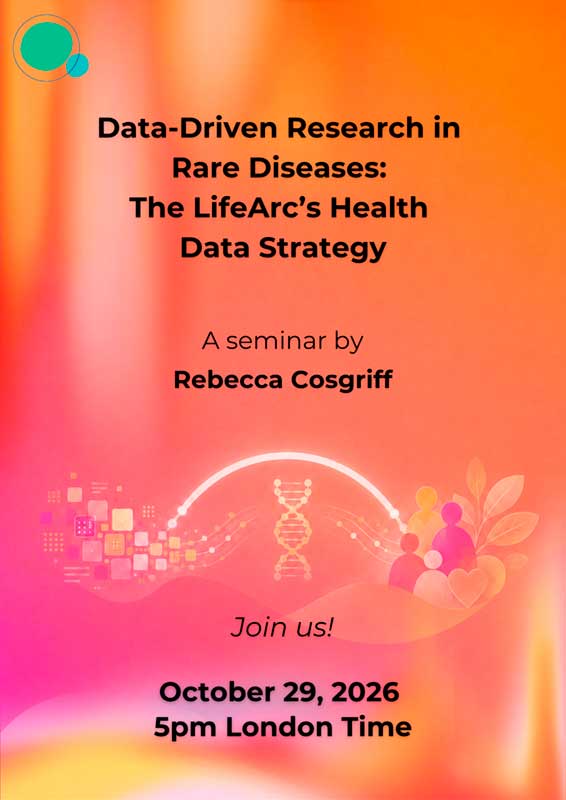
Data-driven research in rare diseases: the LifeArc’s health data strategy.
October 29, 2026 5pm London UK
This talk explores how health data can be translated into tangible benefits for people living with rare diseases. Drawing on LifeArc’s Health Data Strategy, the session examines the challenges that have historically limited data-driven research in rare disease, and the opportunities created by emerging national data infrastructure, advanced analytics and cross-sector partnerships. Rebecca outlines LifeArc’s approach to harnessing data to accelerate diagnosis, improve clinical trials, generate evidence to support adoption, and strengthen the wider research ecosystem.
OUR SPEAKERS 2026
- Rebecca Cosgriff
- Adam Hoyhtya, MS
- Aimee Walker-Clarke, PhD
- Andrew Walker, PhD
- Anke-Peggy Holtorf, PhD, MBA
- Charles Swanton, FRCP, PhD
- Daniel Aaron, JD, MD
- Fleur Chandler
- Fred D. Ledley, MD
- Gemma Taylor, PhD
- Grace Jennings, PhD
- Josie Godfrey
- Karen Facey, BSc, PhD
- Kerry Leeson
- Kseniya Prudyus, MSc
- Laurence Clark, MD, FACP
- Lindsay Birrell
- Nikki Holliday, MSc
- Oriol-Sola Morales, MD, PhD
- Piers Mahon, PhD
- Raffaella Ravinetto, PhD
- Reuben Guttman, JD
- Riley League, PhD
- Sophie-Mira Roberts
- Stelios Theophanous, PhD
- Stephany Saarti, PharmD
- Umbereen S. Nehal, MD, MPH, MBA
- Vanesa Huerta Carrera, MSc
- Walter G. Johnson, JD, PhD
- Wen Hwa Lee, PhD